Showing posts with label technology. Show all posts

25 September 2016

How Machines Will Take Over


Google's official mission or vision statement is to organize all of the data in the world and make it accessible for everyone in a useful way.

Advancements in information technology shines a light on the dark side of humanity, exposing it for all to see.

Humans start to lose faith in humanity and turn instead to machines as well as the large corporations that own and control these machines.


29 June 2014

Do you need friends?

I'm starting to wonder whether I need friends. I am in a position in my life now where I love my job and enjoy working, and it is the time I spend outside work with friends and family that bother me. I try to keep my mind away from all the drama among friends and family but sometimes it is just hard to avoid. I am trying my hardest and find that the best way to escape for all the hardship of friends and family is to just do a breakup. For me, I am getting to that stage where a nice evening alone at home streaming a movie or TV show is so much more relaxing and attractive than going to a friend's housewarming or a family gathering where you have to make conversation with annoying people. I am starting to question the conventional wisdom that friends are essential.

23 July 2013

Reasons Behind the Decline of the PC

There is a lot being side nowadays about the decline of the PC as sales of tablets and smartphones boom. I still find the PC to be useful mainly because then functionality of most programs and websites on a bigger screen is enhanced significantly. Furthermore, typing on a physical keyboard is faster than a touchscreen keyboard because the touchscreen is smaller, meaning you need to use your use your thumbs to type, and on a large tablet the fact that there is no tactile feedback hampers the efficiency of touch typing. I can type quickly on a tablet, but not as fast as on a physical keyboard.

Another reason why I like to use a PC is because it is more ergonomic (see Are tablet ergonomics a pain in the neck?). Using a tablet for long periods of time causes your neck to move down and forward because you typically hold the tablet (or smartphone) down and lean down to look at it. A PC monitor, on the other hand, sits vertically in front of you, meaning it is safe.

So why do statistics show the PC is in decline? One reason, I think, is because many people already have PCs. PCs are necessary for email, banking, job hunting, and so forth. Because everyone already has a PC, not many people feel a need to buy another. They will keep it until it breaks. Not many people have smartphones or tablets, but that is changing. Many people are switching from features to smartphones and many are buying tablets.

However, just as many people are satisfied with their PCs and don't bother upgrading to the latest Alienware, I believe the smartphone market is not immune to consumers sticking to their old phones because it is good enough and not worth the upgrade. Many Apple users seem to stick with the iPhone 4 rather than upgrade to the 5 and I see many Samsung users sticking to their Galaxy S3 or S2.

One factor working in the smartphone's favour is that the smartphone is a public device. I carry my smartphone around with me and many people see me with my smartphone, so if I were very sensitive about other people's opinions of me, I will buy a beautiful and powerful smartphone to show others that I am stylish but also technologically sophisticated. The PC and tablet, on the other hand, stays at home, so getting something good enough for the lowest cost is the priority.

Many people carry tablets around, e.g. to play games or swatch movies on the train, but I only ever keep my Nexus 7 at home. I normally don't carry anything with me other than a phone, keys, and a wallet. I find it inconvenient to carry a bag or briefcase, and with everything done electronically nowadays, I think it is unnecessary.

To me, a tablet and desktop computer are similar in that they are devices used at home that offer more screen size than the smartphone. At home I rarely use the smartphone because I prefer the bigger screen on a tablet, and if I need a physical keyboard I use the PC.

PC software tends to offer more functionality than the tablet, but not by much, and although I prefer a physical keyboard, many people may not care, and if this is the case many people may find that they can save money by doing without a $500 PC and instead use a cheaper tablet. Decent tablets like the Nexus 7 cost around $200 to $300. You can check email, Facebook, do internet banking, pay bills, and job hunt on a tablet. You don't need a PC. Even if you do need a physical keyboard, you can simply buy a $50 Bluetooth keyboard to pair a $200 Android tablet, and you effectively have a laptop that costs less than most PCs (PCs typically cost around $500 or more).

All these factors I think explain the decline in PC sales. PC manufacturers should just switch and focus on making more phones and tablets.

26 May 2013

Kogan Agora 5 Dual Core Smartphone ANTUTU BENCHMARKS


I purchased a Kogan Agora 5 dual-core smartphone from kogan.com.au about a week ago when Kogan was offering free shipping. This meant that I paid $149 for the phone rather than $169 for the phone with postage and shipping costs.

This is a 5-inch smartphone that I purchased for my mother for Mother's Day. Unfortunately, my mother used it for one day, found that it was too big to fit in her pocket, and went back to using her old Samsung Galaxy Y Duos. I therefore gave it to my father who gave it to his children (my siblings), and they use this phone as a portable gaming device.

In my opinion, this phone is excellent value. It is no Samsung Galaxy S4, but instead of paying A$700 for the GS4, you only pay A$149. The Agora 5's dual core processor allows it to be fast enough. The battery life is enough to last a day with 2000 mAh, which is decent. The display's pixel density is on the  low side at around 180 ppi, which is about equal to that of the iPad mini. The Agora 5's display is not anywhere as good as the full HD 1080p displays of the GS4, Sony Xperia Z, or HTC One (440 ppi to 470 ppi) but it is good enough. The colours on the Agora 5 appear washed out and lacks vibrancy. Nevertheless, these criticisms are not major and considering it is only A$149, it is forgiveable.

Today I performed an Antutu benchmark test on the Agora 5. It scored 6547 (see image above). This is definitely on the low side. The Kogan Agora 10 dual-core tablet scores 11505 on Antutu. I believe the main reason why the smartphone scores poorly on Antutu given it is dual-core is because it only has 0.5 GB RAM whereas the Agora tablet has 1 GB RAM.

That being said, my siblings like to carry the Agora smartphone around with them for portable gaming likely because it is portable and lightweight. The Agora tablet, on the other hand, like the iPad, is too heavy to simply carry around with you. Unlike the more expensive iPod touch, the Agora smartphone is faster, has a bigger screen, and can be used as a telephone, which I think makes the Agora a better gift for children.

08 May 2013

Kogan Agora 5 Dual Core Smartphone

The current phone I am using is a Sony Xperia Z, which I really like. I purchased the phone for about $700 from Kogan, and about a month or so later I notice that it is selling on Kogan for about $550. I probably should have waited.
I will likely go travelling soon to Malaysia. When I go travelling, I don't want to bring my Xperia Z along because, when travelling, I will be throwing my phone around and treating it roughly. It will be crammed in suitcases and SIM cards will be taken in and out, and I may drop it or have it stolen. Instead of carrying around a $500 or $600 phone that is made of glass and that looks very premium, I'd rather bring along a cheap phone for travel.
That is why I purchased the Kogan Agora 5. It is only A$149, and every now and then Kogan has free shipping. Today is one of those days.
Before buying the phone, I've done some googling. I've checked YouTube videos. I've also checked the hardware specifications.
Based on my googling, I don't expect this phone to be as great as phones like the Xperia Z, HTC One, or Galaxy S4. But these high-end Androids cost about five times more.
What really attracts me to the Agora 5 is that it has a dual core processor, which is not typically of phones in this price bracket. A dual core processor is not in the same league as the quad core Xperia Z or HTC One or even the octocore GS4, but since a lot of software is only designed for single or dual core processors, having a dual core processor is often enough. Dual core puts the Kogan into the same league as the Apple iPhones, which are all dual core, (although the cores of the iPhone are not Cortex A9 processors).
The major problem with the Agora 5 is its poor display with its low resolution pixel density of 186ppi, which is about the same pixel density as the iPad mini's horrible display. This is terrible compared to the full HD 1080p displays currently out with pixel densities ranging from 440ppi to 470ppi. Nevertheless, I decided to buy the Agora anyway because 186ppi is not that bad. Low pixel density is bad for reading. It can hurt your eyes. I don't plan to read much while I travel. There is no point travelling if you're just going to read on your phone the whole time. You may as well stay home and read on your tablet. I plan to just do light emailing, Facebooking, and instant messaging when I connect to a hotel's WiFi. Therefore, I will read, but I won't read much. If I really want to pass time, I can play light games.
Another issue with the Agora 5 that I have read about is the camera. Although 5MP seemed adequate, I have read that the camera is horrible and that it does not produce realistic colours. I checked some sample pictures out and though that although it is not perfect, it didn't look that bad, and it certainly looked good enough. Many people are very picky about their phone cameras and are especially concerned about accurate colour reproduction, but in don't mind it too much if the phone goes crazy and makes the colours more vivid horns bit different. It livens upon boring images. I'll have to wait until I actually get the phone before I test there camera. I will put sample photos up.
When I am not travelling, I can use the phone as a backup phone, or if I find someone who still uses a dumbphone, I can offer the phone to them as a gift. I find that smartphones make excellent gifts. I gave my old HTC Desire HD to my grandma and a Samsung Galaxy Y Duos to my mother. These are cheap phones, but people tend to perceive smartphones as very expensive devices, which explains why companies like Apple and Samsung can get away with pricing their phones so high even though it cost them little to make. My prediction for them future is that as time goes by, consumers will understand what they are buying and will choose devices based on price and specs, which will result in competition that will cut margins and make it difficult for companies to make profits. It's already happened in television. In see it happening in phones.

29 March 2013

My Experience with the Sony Xperia Z

For years, Sony Ericsson has made bland and boring phones while Apple and Samsung dominated the smartphone market to create an effective duopoly.

Sony has cut ties with Ericsson and wanted to make a phone that signalled to the world that Sony was serious about smartphones. The Sony Xperia Z was born.

I've had the Sony Xperia Z for a few days now and overall I can say that I am very happy with the phone. I purchased it online via Kogan and had to wait about two weeks before it was sent to my house. I love buying goods online because of cheapness, but it is terribly difficult waiting for a phone that I really desired. Nearly every day while waiting for the phone, I went on YouTube and searched for the latest videos on the phone. This kept me interested as I waited. I absolutely loved Sony's advertising for this phone.

Battery

My old phone was the HTC Desire HD. I've had this for about two years and it has served me well. The main problem with the Desire HD is the battery life. The phone's battery capacity is around 1230 mAh (compared to 2330 on the Xperia Z). I would charge the phone overnight, use it on the train when commuting to work, and use it intermittently for email, messaging, and calling throughout the day. By around two in the afternoon, the phone would be dead! The battery was that bad. I was able to partially fix this problem by getting a $2 USB to micro-USB connector from eBay and charging the phone at work from my computer. This was also useful because it allowed me to easily transfer files from work to home if I wanted to. I didn't need to carry around a USB flash drive. I could live with the Desire HD's poor battery life, but I preferred a phone that lasted for a whole day, at least.

The Xperia Z's battery life, I have found, is phenomenal. I charged it overnight and, when using it normally I have found that the battery is around 60 to 70 per cent full by the time I get out of work. It easily lasts the whole day with normal use and will probably last two days as well. The Xperia Z's 2330 mAh is nothing revolutionary, especially compared to the Samsung Galaxy S4's 2600 mAh battery and the Samsung Galaxy Note 2's massive 3100 mAh battery. However, the Xperia Z comes with a built-in power management software called Stamina Mode that automatically turns off power-intensive features like mobile data. Stamina Mode is customizable, so you can specify which programs are not affected by it. For example, if you use Whatsapp or Facebook Messenger to keep in contact with family and friends, you can customise Stamina Mode to ignore these apps.

Design

The killer feature of the Xperia Z is its aesthetics. It is a beautiful phone, a work of art. While the Samsung Galaxy S4, I am sure, is technologically superior, its design is similar to the S3 and is getting boring. The new Blackberry Z10 looks like an iPhone 5 with a plastic back. The LG Optimus G Pro is starting to look like there Galaxy phones as well. The Xperia Z, on the other hand, does away with curved designs and opts for a minimalistic thin and sleek black slab with sharp edges, symmetry, and shiny, reflective glass. Whenever I take this phone out of my pocket at work or lay it down on a table, just about everyone says, "wow!" "whoah!" or something similar, and typically want to touch it and play with it. The phone comes in black, white, and purple. Black is best.

The Xperia Z is not as thin as the iPhone 5, but the two are very similar, and to the naked eye the Xperia Z looks slimmer and better proportioned because it is wider. The width and tallness of the Xperia accentuate its thinness. The iPhone 5 is simply a taller and thinner version of the 4S. In their attempt to maintain better one-handed operation, the iPhone 5 looks too tall and anorexic. It is a feminine and emasculating phone compared to the manly Xperia Z. The iPhone 5 has a really small 1440 mAh battery, which is pathetic, but the iPhone has a blurrier display compared to the Xperia Z, so its power consumption should be lower.

I am using my Nexus 7 tablet to write this blog, so the pictures of the Xperia Z I have posted here use the Nexus 7's low-resolution front-facing camera. Unfortunately the Nexus 7 has no rear camera.
Another issue with the phone is that it attracts fingerprints and dust like a magnet attracting metal. Be prepared to wipe it all the time.


Waterproofing

The Xperia Z is waterproof up to one metre. This means you cannot go swimming or scuba diving but you can use it in the shower or bath tub. The waterproofing is excellent because you never know when someone will push you into a swimming pool or lake. You may also drop your phone into the toilet. I take my phone into the shower with me and place it in the shampoo rack. When people call me while I am in the shower, I can tall to them, and theoretically I could Skype people while in the shower as well, but I am hesitant to try this.
Taking the phone into the shower also allows me to clean the glass panels of the phone to remove fingerprints.

That being said, the downside of waterproofing is that all ports, such as the micro-USB port and micro-SD port, have plastic flaps covering them, and you have to constantly detach and reattach these flaps if you want to charge or even put headphones into the phone. I will be getting a charging dock for the phone, so charging is not an issue. If you are into music, you will probably need to invest in expensive NFC-enabled wireless headphones. That being said, I am willing to tolerate this I'm order to get waterproofing.

Comfort
 
Although the Xperia Z is a beautiful phone, it is not comfortable to hold. My old HTC Desire HD had a rounded aluminium back that fitted well into the hand. Likewise, my Nexus 7 has a curved rubber back that feels really nice. The Xperia Z, on the other hand, has sharp jagged edges and flat glass surfaces, which feels uncomfortable compared to the Nexus and HTC. Once again, I'm willing to tolerate this, but others may not.

Conclusion

Much was said about this phone's poor colour contrast and viewing angles. I can attest that the viewing angles on this phone are far from perfect, but who looks at a phone screen on an angle? My experience is that the display is fine. The fact that it is Full HD, 1080p is a plus. It makes images and text crisp and clean. I read a lot on my phone, so high pixel density and big screens are non-negotiable.


24 March 2013

My Experience with the eCoffeeCard App

I love my coffee. At some coffee stores I visit, there are loyalty cards where you can get a free coffee if you buy, say, 10 coffees. However, for one area I go to, they have encouraged their buyers to use eCoffeeCard, a smartphone app that keeps track of how much coffee you've had and notifies you when you're due for a free one.

I installed this app on my Android phone and used it for a while. My experiences have been negative.

Technology is supposed to make life simpler and easier. It is supposed to make you more productive. I have found that eCoffeeCard has done the opposite.

Normally when I pay for coffee, I use cash, and if there is a loyalty card, I hand this card with the cash and the barista signs the card or punches a hole in it. The barista then hands the change and card back to me. It's quite simple.

However, with eCoffeeCard, I have to pay separately with cash, then I have to take my phone out of my pocket, I have to turn it on, search for the app icon, wait for the app to load, and then I have to scan the QR barcode, and then wait for the app to recognise the barcode. Using the smartphone is significantly slower!

Normally when I buy coffee, there is a queue, and being slow means you hold everyone up.

I don't know what the solution is. Perhaps Google Glass will fix everything because you will only have to look at the barcode rather than bother with taking out your phone, etc.

15 March 2013

First thoughts on the Samsung GALAXY S4


The Samsung Galaxy S4 (or Samsung Galaxy S IV) was released today. It was released in New York, which meant that here in Australia it was released at around nine or ten in the morning, which coincided with when I was at work. I got out of work at eleven today but missed the opportunity to watch the Samsung presentation live on YouTube.

The Galaxy S4 is nothing surprising. It pretty much looked exactly like the leaked pictures. The hardware specifications are what were expected. It has a five-inch super AMOLED display with full HD, 1080p at 440ppi. The display size and pixel density matches phones like the Xperia Z and HTC One but what is great about Samsung phones are the fact they use AMOLED displays rather than conventional IPS LCD displays. AMOLED displays give deeper blacks and more vivid and bright colours. Some people do not like th vividness of AMOLED displays, saying it is unrealistic. It's a matter of preference which one you prefer, but I prefer AMOLED.

The Galaxy S4 has an unprecedented Exynos 8-core processor. The octacore processor has four performance cores and four economy cores. When performing power-intensive tasks like gaming or watching videos, the performance cores are used whereas the economy cores are used when you are engaged in mundane tasks like web browsing. Along with the 2 GB of RAM, this allows the S4 to achieve an unprecedented 26,000 score on the AnTuTu benchmark, which is 6,000 higher than the runner up HTC Buttery's 20,000 score. This makes the Galaxy S4 the fastest and most powerful smartphone yet.

There are numerous other features on the S4, far too much to digest in this blog post. Many people claim that these features are not "proper innovation," or evolutionary rather than revolutionary features. But this is subjective. I happen to believe the octacore processor and AMOLED screen are highly innovative, but others may not think so. Many believe Apple's first smartphone, with touchscreen-only input and apps was innovative, but closer inspection reveals they are evolutions of Microsoft handheld devices like the Palm Pilot. Apple simply improved the specs and marketed the product very well.

In my opinion, the Galaxy S4 is technologically superior to any other phone on the market today. Where the S4 is criticized heavily is in the plastic material is uses for its body. Samsung have good reasons for using plastic. For one, it absorbs shock better, which means dropping it will damage it less compared to, say, a glass phone like the fragile Nexus 4. Metal phones, such as the iPhone 5 or HTC One, tend to scratch easily. Most people, when they buy a metal or glass phone, put a plastic case on it anyway for the very reason that they don't want to damage the metal or glass. Premium material is only a concern for those with so much money that, if they crack a glass phone or scratch a metal phone, they can simply afford to buy another one. Many people, when criticizing Samsung phones, refer to the "build quality." I hate it when people use this term because plastic Samsung phones don't break. The plastic actually improves its build quality. Instead of using the term "build quality," we should call it what it is and use the term "snob appeal." Samsung's plastic phones are technologically superior to any other phone out there, but lack snob appeal because plastic is perceived to be cheap and nasty.

That said, I do not mind owning a nice-looking phone. The benefit of Android is variety. For those who want glass, there is the Sony Xperia Z, which is by far the prettiest phone yet. For those who want aluminum, get the HTC One. For those who want value for money, get the Nexus 4.

02 February 2013

Kogan Agora 10" Dual Core Tablet

Today I visited my father's house and noticed that my five-year-old half-sister held a 10-inch tablet in her hands. I asked my father about the tablet and he notified me that he had purchased two 10-inch Android tablets from online retailer Kogan.

Since one of her friends purchased a Sony tablet, my half-sister has been wanting a tablet for herself. I remember when we visited the shopping mall, she would say to her father, "I want an iPad!" and then point to a Samsung Galaxy Tab. It's not good to reward bad behaviour, but learning how to use a tablet can have educational benefits and can allow the child to familiarise herself or himself with the latest technology. Not to mention that fact that nothing mutes a loud and reckless child as effectively as a tablet PC.

In my opinion, Apple's main innovation is in its marketing. Their marketing and brand recognition is so strong that many children (and even most uninformed adults) refer to all tablets as iPads, regardless of whether they powered by the Android or Windows operating systems or whether it is made by a company other than Apple, e.g. Samsung, HTC, Sony, Motorola, or even Microsoft. But given that the latest iPad 4 would cost around $600, it just seemed stupid buying an iPad 4 for a child when the child would likely drop, break, or spill food on the device.

My cousin, thinking that she was saving hundreds of dollars by not buying the latest iPad 4, purchased instead an iPad 2 for $400. Given that it is an iPad 2, it has a low-resolution display (NOT the iPad 4's high-resolution 264ppi Retina display) and it only had a measly 0.5 GB RAM and used an ancient and weak 0.8 Ghz single-core A5 CPU. Why would you spend $400 on an iPad 2 with ancient technology when you can spend less than half that much ($180) and get a Kogan Agora 10" Dual-Core Tablet? The Kogan Agora tablet is more than two times cheaper than the iPad 2 yet also has a dual-core processor, has two times more RAM, and has a bigger battery.

That being said, the Kogan Agora 10" is not the best of the best. I would argue that the best tablets out now are the Nexus 7, Nexus 10, iPad 4, and Asus Transformer Prime. But these tablets are generally quite expensive whereas the Kogan Agora 10" is $180 whereas the smaller 8-inch Kogan Agora Dual Core Tablet is only $120. The Kogan Agora 10" also has a respectable 1 GB RAM, which is equal to the amount of RAM in the iPad 4. When I looked at the screen of the Kogan tablet, I noticed that the display was pixellated and blurry compared to the crispness of the iPad 4 and the Nexus 7. Nevertheless, for a $180 tablet, what do you expect? For most people, the low-resolution 132ppi display on the Kogan Agora tablet it is not a huge issue. It is approximately equal to that of the iPad 2. If you want high-resolution on your tablet, you'll need to pay more. The iPad 4 has an impressive pixel density of 264ppi Retina display but will cost you $600. The Google Samsung Nexus 10, however, has an even better pixel density of 300ppi and will cost you $500.

How is the battery? According to Kogan's website, the Agora 10" Dual Core has 8000 mAh. The website does not give the actual battery life of the tablet in hours, and I was not able to test it given the children were playing on it. Nevertheless, the iPad 2 has a 6,944 mAh battery and goes for about 10 hours, whereas the new iPad 4 has a 11,666 mAh battery, which is roughly 70% larger, yet still goes for about 10 hours as well given that the iPad 4 has a high-resolution Retina display and dual-core CPU, it consumed much more power. Given that the Kogan Agora has a dual-core CPU like the iPad 4 but has a low-resolution display like the iPad 2, my rough guess is that battery life will be around 10 hours as well.

I went into the Kogan Agora's browser and also played some Angry Birds to see if the tablet could handle it. It seemed quick and responsive, so it is likely that the dual-core CPU is doing its job. The kids installed various games on the tablet and played them. There seemed to be no issues with performance. The Kogan Agora also runs the latest version of Android, i.e. Jelly Bean, which is supposedly much faster than previous Android versions. All in all, I was impressed. When they carry it around with them, the children keep referring to the tablet as the "iPad," and I keep telling them, "it's a Kogan!" but they don't seem to understand.

Given that I am used to the Nexus 7, what surprised me about the Kogan Agora 10" Dual-Core is that it is quite heavy. Furthermore, even though the Kogan website says the tablet uses USB, the Kogan Agora does not seem to charge with a standard micro-USB charger but has a completely different charging connector, so if you run out of batteries at a friend's house, chances are you will not be able to use his or her charger. I would prefer it if the tablet used micro-USB, but given it's only $180, I'm willing to forgive.

The Kogan Agora 10" Dual-Core has a premium feel to it, even though it is plastic. Although it is heavy, it is thin, black, and sleek. Carrying it around gives off a premium look, that is, until people notice the "Kogan" logo on the back.

If you go to Kogan's Facebook page, you will notice that Ruslan Kogan receives many complaints. Reading his Facebook page, you'd think the man is completely incompetent. But my experience with him (as well as my family's experiences) has mostly been positive. I have purchased a Nexus 7 from him and a car charger. The items took a bit of time to come (maybe a month) but this was fully disclosed on the website and I was happy that it eventually came. Furthermore, Kogan seems to be able to sell goods that are much cheaper than the brick-and-mortar retailers. For example, the Google Asus Nexus 7 sold on his website is cheaper than the same tablet sold directly from Google Play. Kogan also sells a Kogan branded 5" dual-core phablet smartphone for only $150, which is absolutely incredible given most good smartphones from Samsung or Apple cost $600. Kogan may be a controversial figure who has upset many, but there is no question that he delivers for the customer.


Update 9/2/13: I have performed the Antutu benchmark test on the Kogan Dual Core tablet. It received a score of 11505. This is very good.


11 November 2012

HP v250w USB Flash Drive

I have made an impulse purchased at Officeworks to buy a USB flash drive. It was only about $12 and the main feature that attracted me to this flash disk was the fact that it can easily clip on to your keychain. This means I can carry a USB stick with me everywhere I go without thinking about it. It is perfect when I am at work and suddenly feel the need to bring some files home (encrypted, of course). I also love how it's so shiny and metallic.


11 June 2012

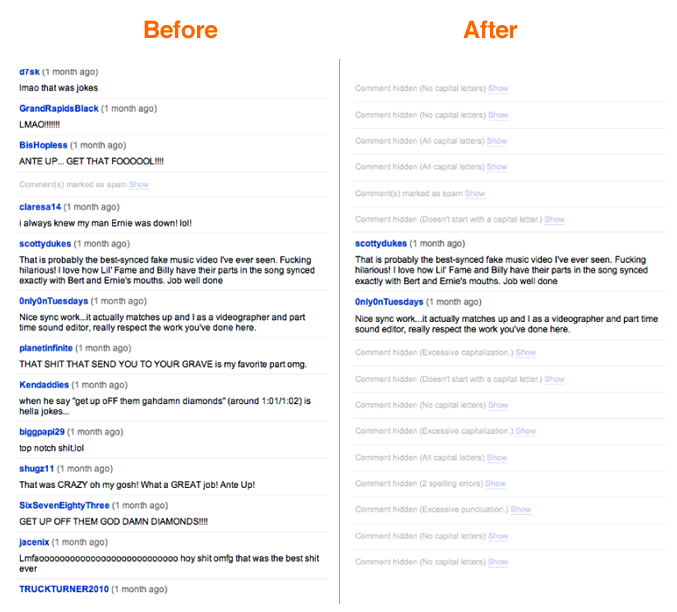
How to block Youtube comments


I hate it when I'm watching a movie or show online on Youtube and then someone reveals a spoiler in the comments. I also hate how Youtube is filled with vulgar comments. Thankfully, I have found a solution. It simply involves having Firefox and installing an add-on called YouTube Comment Snob!

This add-on not only allows you to block all comments but also, if you want, allows you to filter out ones with too many spelling or punctuation mistakes, which ensures that the comments that remain are likely to be the more educated ones. I would recommend this add-on for teachers who want to block vulgar comments so that Youtube is safe for children.

Image: waxpancake

10 June 2012

Facebook is not to blame for burglary

The Age has published an article titled The problem with oversharing: why burglars like you using Facebook. The article suggests that if you posts something on Facebook that burglars will know exactly where you are and, if you are not home, they will go into your house and rob it.
IT SEEMS harmless enough: announcing your holiday plans on Facebook or uploading that dinner party photo to Twitter. But according to cyber safety experts, such posts are a gift to burglars and stalkers. ''Not only are you telling me where you are, you're telling me where you're not,'' says cyber safety consultant and former police officer Susan McLean. ''And I could get that photo, run it through a program and find out exactly where it was taken.'' One New South Wales family learnt just how dangerous this can be when they were robbed at knifepoint recently, hours after their daughter posted a photo of her grandmother's savings - in cash - on Facebook. Just before midnight, two men broke in and demanded to speak to the girl, who was not home. They then stole money and property from her terrified mother.
It is certainly possible that you can reveal your location by posting pictures to Facebook, but how Facebook differs to a website is that it is not open to the public unless you allow it to be. Only people you approve to see the pictures can see the pictures you post. And if your friends are the ones robbing you, you should not be approving them on Facebook to see your photos anyway. If you don't know whether your friends are burglars or not, posting a picture on Facebook is no different to if you handed a physical photo to that friend, only Facebook is far cheaper and efficient. The problem therefore is not Facebook but that you shared photos with a friend who you shouldn't have.

07 June 2012

Did Samsung copy Apple?

Apple is up to no good again. In an effort to impede the success of Samsung's flagship smartphone, the Galaxy SIII, Apple is suing Samsung.

Apple should focus on making phones. The fact is that just about all phones are copies in that they take existing technology and improve it. The iPhone is not original and copied technology e.g. the touchscreen and app idea came from the IBM Simon. The iPhone 4S is definitely an improvement on the IBM Simon, but nowadays the 4S is an overpriced dinosaur. For the same cost (or slightly more) you can get far more powerful smartphones e.g. the HTC One X. This is just natural evolution of phone technology.

03 June 2012

Facebook phone is a good idea

There is an article on The Age titled Facebook smartphone? Dumb idea that criticizes the idea that Facebook may create its own line of smartphones.

The article states that there is not much money to be made in smartphones. According to the article, there are two ways of making money in the smartphone industry: the Apply way, which involves creating a phone that is worth $150 and then selling it for $800, thereby making huge profits and making Apple one of the biggest publicy owned companies in the world; the Android way, which involves creating a phone at a cost that varies from $100 to $800 and selling it for only a little bit more, thereby making small profits.  The article assumes that Facebook will opt for the Android way and maybe use the free and open Android operating system or create its own operating system and gain market share by heavily subsidizing the phone and lowering its cost considerably. Facebook intends to make money by gaining large market share and then putting ads on the phones.

I don't think this is a bad idea. However, the article states that this is a poor idea because Facebook is already integrated in most Android and iOS phones. This may be true but Facebook does not control the prices of these phones. Rather, Apple, Samsung, HTC, and so forth control the prices. If Facebook makes a phone, it can subsidize heavily and undercut the rest.

I wouldn't mind buying a supercheap phone and have ads on my Facebook. I'd rather see ads on my Facebook than pay more money on a phone. Comparing smartphones with 1GHz processing power only, currently you can buy a iPhone 4S outright for about $800. You can buy an HTC Desire HD smartphone with 1GHz processing power for $380 outright and unlocked. Suppose Facebook offered a smartphone that was only $150 outright and unlocked with Facebook installed with ads. I certainly would buy it. In terms of value for money, it makes sense. Anyone who is smart with money will do the same things. Facebook will steal customers from Apple, Samsung, and HTC phone users and make more money from advertising revenue. Sounds very smart to me.

28 December 2011

The Benefits of Putting Everything on the Internet

My desktop computer is ruined. It started to play up a few days ago but now it doesn’t even boot up. Whenever I turn it on it just has a black screen. Luckily I was able to backup everything while it was playing up, and most of my important files are either on my external hard drive or on the internet. I think at the end of the day it is much better to have stuff on the internet because then you don’t have to worry about your computer stuffing up and having your files lost. It is always possible for e.g. Google or Facebook to fail one day and all your files stored with these companies will be lost, but I would imagine that the likelihood of Google or Facebook failing is much lower than the likelihood of my own desktop computer failing. I can rely on my desktop computer failing every few years, based on history. Furthermore, if there are really important files that you want to preserve, simply make copies of it and upload it to multiple websites. Even though my desktop computer is stuffed, I am able to write this because I am using my laptop.

31 July 2010

Youtube Subscription Bar

I do not like Youtube's new subscription bar that appears when you try to view your subscriptions. It gets in the way of all the other buttons you need to press. It's unfortunate that Youtube didn't give users the option to turn it off.

24 July 2010

Beware of Online Shopping! My Post Office Experience

I like shopping online because generally prices can be cheap. Shopping online allows you to find prices of many suppliers, thereby increasing competition. The fact that these suppliers don't need to pay rent on a store means that they can pass the savings to the consumer in the form of cheap goods. However, there is a major problem with online shopping that I will share with you.

I like online shopping because I don't have to deal with people. I can order something online and have it delivered to my door. It is extremely convenient.

However, one day I ordered some mugs online. I waited about two weeks and the mugs never came to my house. I emailed the supplier and asked why my mugs were taking so long, and they replied by saying that their supplier came to my house but becaue no one was there the mugs went to my nearest post office. I just had to go to the nearest post office to pick up the mugs.

Because I work full-time, I am often not home, so apparently I needed to sign the courier's package to acknowledge that I received it.

I was annoyed that I had to go to the post office. I purchase things online because I want the convenience of not having to drive to an actual place, and now I have to drive to the post office! I went off the post office and told the woman there that I had a package for me. I told her approximately when it should have arrived. They asked me for some reference number. I didn't have any reference number. The supplier didn't give me one. After about five minutes, during which the woman rummaged around, I finally got the mugs. The woman at the post office was extremely rude as well! At least when I shop at a physical store the person there is very kind to you because being rude to a customer is not good business. When an online store sends a good to a post office, it is incredibly difficult because post office employees are government workers who cannot be fired regardless of how bad their customer service skills are.

This incident scarred me for a while, and for about a year now I have stayed clear of buying things online. How in the world can this problem be solved? I don't want to have to go to the post office again but I still want the cheapness and convenience of buying online. I don't know what to do!

22 July 2010

The Great Gatsby

This blog post contains spoilers.

In an earlier blog post I spoke about how I have installed a free ebook application on my mobile phone. The program allows me to put text files from my computer onto my mobile phone. Since I can download free ebook text files from Project Gutenberg, I am able to now read plenty of books on my mobile phone for free. Project Gutenberg does not have text files for every single book. However, books published before a certain year (around 1940) are in the public domain and are therefore free. There really is no reason for anyone to buy a book because there are so many free books out there. The first book I read on this ebook reader is The Great Gatsby.

This novel is about a man named Gatsby who became wealthy through questionable means (organized crime) and then tries to attract a female named Daisy who is already married to a man named Tom Buchanan. Tom comes from a family that has always been rich whereas Gatsby is self-made. Gatsby attempts to attract Daisy fail and at the end Gatsby is killed. Hardly anyone attends his funeral and we learn that Gatsby really was a mysterious figure who misrepresented himself greatly.

I read this novel having heard the hype about how this was one of the greatest novels of human history. Many have called it the Great American Novel. In my opinion, The Great Gatsby was a bit of a disappointment because much of the book is quite boring. I do feel pity for Gatsby, the main character in this novel, and I do think that some of the themes in the novel do indeed play out in real life.

26 April 2010

1080P vs 1080i

I purchased a WD TV HD Media Player (Full HD 1080P) from Dick Smith fro $167. I purchased it instead of the 1080i version, which only cost about $70, so I spent quite a premium for 1080P rather than 1080i. The salesperson at the shop told me that 1080P is a superior product. I purchased the 1080P but now I am starting to wonder whether I made the wrong move. I have read that 1080P is better, but from what I've read on the internet, not many videos use 1080P anyway, so I may have overpaid.

I also feel as if I have been a victim of shifty marketers because the 1080P box was massive while the 1080i box was small. When I opened the 1080P box, the actual machine in there was quite small and most of the box was just air. I feel as if the producers of the product called the 1080P "Full HD" and made the box bigger in order to justify the price premium.

This media player allows me to watch videos on a hard drive on my TV, which is awesome because I don't really like watching videos on my computer and because free-to-air TV has a lot of crap on it, and so it's important to be able to pull up some quality video content when free-to-air fails to deliver. What I find annoying about free-to-air in Australia is that especially on the weekends they show nothing but sport. More variety is needed.

Update: I know I have overpaid for the media player because (see screenshot below) I have been browsing through the internet and found a similar product for $130 instead of $167! The lesson here is that you should do your research before you shop and not purchase based on impulse. It is a good idea to look on the internet first before you head to the mall.

24 September 2008

Councils Use Google Earth to Spy on Houses

According to Eye Spy with my Google Eyes, Australian local governments are using Google Earth to see if any renovations from people comply with regulations. They also have access to satellites that are able to pick up an A4 piece of paper in our backyard.

I have listened to a Spoonman argument (on talkback radio) about this topic and many people who were for Google Earth said that the fear over privacy was caused by people being unaware of the technology. They claim that what is in our backyards as well as the look of our houses are public anyway.

Google Earth will not only catch people naked in their bathrooms through open windows but will also catch people walking into adult bookstores.

By broadcasting pictures in public and displaying it on the Internet, Google Earth has set a legal precedent that will legitimize pedophile Jack McClellan's practice of taping little girls at shopping malls and posting the videos up on the Internet for pedophiles to watch.

There are many times in public when you make a mistake. If few people are looking at you, it's not a major problem. However, if someones takes a picture of you and puts it on the Internet, you are in trouble. For example, what if you are at the beach and suddenly you accidentally let your bathers fall down so that your private parts are exposed. Then someone takes a picture and posts it up on the Internet so that your private parts are exposed for the whole world. Even if you have children your children may accidentally expose too much flesh (e.g. by taking their shirt off) and then someone like Jack McClellan may take a picture and post it up on the Internet. Since no private parts are showing the picture may not be classified as child pornography, yet your child may be traumatized by this.

Some people claim that if you ask Google to remove embarrassing pictures, they are likely to do so. This is fine, but it is the legal precedent I am concerned about. If Google is allowed to take pictures and post it up on the Internet, then what is stopping anyone from doing the same? What is stopping Jack McClellan from hunting for little girls and posting pictures online?