It's not looking good for the world economy!
The American market has just tanked 3 per cent in a day and Nouriel Roubini is calling a double-dip recession. I am really worried because I have about 75% of my wealth exposed to the stock market and I just know the stock market will tank. I was close to 100% in stocks during the recovery after the GFC, hoping to take advantage of the stimulus-fueled recovery--and it worked out well!--but for the last seven months I've been worried about a double dip recession and have gone into cash and bonds, but unfortunately it seems like I could not buy cash and bonds fast enough. In desperation, I am thinking of selling stocks in my retirement fund, which should see my overall stock market exposure reduced to 60% which I think is reasonable. The only problem with this is that switching investments in your retirement fund is not a quick process and may take a fortnight. Between now and next fortnight, a lot can happen in the financial markets.
Showing posts with label recession. Show all posts
Showing posts with label recession. Show all posts


14 January 2009
Government Jobs Seem Recession Proof
According to an article in the Wall Street Journal (Yearly Job Loss Worst Since 1945), the job losses we are seeing now are the worse since the Great Depression.
Looking at the graph provided, it looks as if construction jobs are worst affected, which makes sense given the collapse of the real estate market. Interestingly, government jobs seem to be unaffected by the recession.

Looking at the graph provided, it looks as if construction jobs are worst affected, which makes sense given the collapse of the real estate market. Interestingly, government jobs seem to be unaffected by the recession.

25 October 2008
Property a Safe Haven from Volatile Shares?
Some people are saying that dropping share markets in Australia will see most investors putt their money into property, which is allegedly safer. The Rudd Government has also increased the First Home Owners Grant (FHOG), which makes it tempting for some people to buy property.
However, I will argue that the share market and the property market do not exist independently. One affects the other.
When the recession hits, Aussie businesses will not longer require as many immigrants, which will reduce the numbers coming here, which will reduce demand for houses, which will reduce house prices.
As unemployment increases, people will have less money to buy houses, which means demand decreases, decreasing prices of houses. Many of those workers laid off will not be able to pay off mortgages, meaning they will be forced to sell, meaning more houses flood the market, which decreases prices.
I have been looking at the economic analyses of economists Steve Keen at UNSW and Robert Shiller at Yale University. They show that real house prices in all countries over many centuries are constant at approximately 3 times average yearly income. Australia currently has the most expensive houses in the world at 7 or 8 times annual income. We are in the same position as California was before property crashed there, causing house prices to decline 40% in one year.
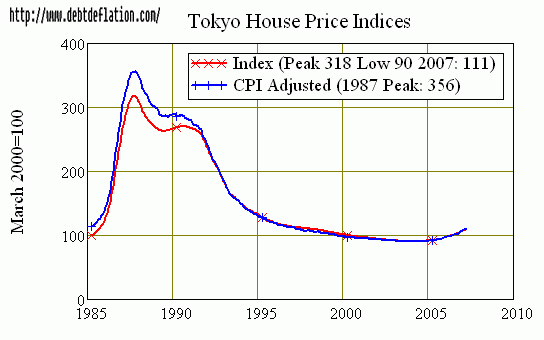
Some people say that property increases in the long term. They say that it may be the case that American house prices are going down, but in the future it will increase again. This may be true, but consider that historically property prices stagnate for long periods of time. Take house prices in Tokyo. After the 1990 Banking Crisis in Japan, property prices in Tokyo plunged by 70 per cent from then (1990) till today (2008). This means that in 18 years property prices have gone down by 70 per cent. Who knows how many more decades it will take before Tokyo property prices go back up to the levels it reached in 1990?
Related Podcast: The Property Bubble (Counterpoint)
However, I will argue that the share market and the property market do not exist independently. One affects the other.
When the recession hits, Aussie businesses will not longer require as many immigrants, which will reduce the numbers coming here, which will reduce demand for houses, which will reduce house prices.
As unemployment increases, people will have less money to buy houses, which means demand decreases, decreasing prices of houses. Many of those workers laid off will not be able to pay off mortgages, meaning they will be forced to sell, meaning more houses flood the market, which decreases prices.
I have been looking at the economic analyses of economists Steve Keen at UNSW and Robert Shiller at Yale University. They show that real house prices in all countries over many centuries are constant at approximately 3 times average yearly income. Australia currently has the most expensive houses in the world at 7 or 8 times annual income. We are in the same position as California was before property crashed there, causing house prices to decline 40% in one year.
Some people say that property increases in the long term. They say that it may be the case that American house prices are going down, but in the future it will increase again. This may be true, but consider that historically property prices stagnate for long periods of time. Take house prices in Tokyo. After the 1990 Banking Crisis in Japan, property prices in Tokyo plunged by 70 per cent from then (1990) till today (2008). This means that in 18 years property prices have gone down by 70 per cent. Who knows how many more decades it will take before Tokyo property prices go back up to the levels it reached in 1990?
Related Podcast: The Property Bubble (Counterpoint)
10 October 2008
Bad Omen Precedes a Massive Stockmarket Crash
Last night when I was driving back from work I swerved to missed a dead cat on the road. The cat looked intact except for its behind, which was probably run over by tires. There was a pool of blood next to the cat. The thought that maybe this cat was still alive and suffered from excruciating pain made me feel horrible. Parents who do not watch their children can be charged with child abuse, so I don't know why so many cat owners do not watch their cats. Many seem happy to just let them run around on the streets.
When I woke up today and checked the news, I realized that the Australian stock market had tanked. The All Ords had fallen by about 8 per cent to 3900. All up I've probably lost about $8000 or $9000 now. I am thankful that I am still relatively young and have little invested in the stock market. Losing $8000 may seem painful but I have heard about older retirees losing $400,000. I suppose I can be thankful that this depression happened while I was young rather than it building up and hurting me even more when I'm older and have even more money in the market. I am hoping this depression scares the highly-leveraged permabulls away from the market so we can start again with a clean slate from the bottom.
I am tired of all the people saying that now is a good buying opportunity because prices have gone down so much. They were saying this when the market dropped to 5000. They were saying this when the market dropped to 4500. They are still saying it when the market dropped to 3900. I think these people have the gambler's desire to win back losses. I like to use the analogy of the car. Sure, a 50 per cent price reduction in a car seems like a good discount, but just because the price has gone down it may not be a good time to buy. What if the engine in the car has just blown? I fear that the stock market decline may be a rational response to the economic equivalent of a blown engine. The engine that runs our economy (probably debt) is stuffed and now we are entering a phase of deleverage.
When I woke up today and checked the news, I realized that the Australian stock market had tanked. The All Ords had fallen by about 8 per cent to 3900. All up I've probably lost about $8000 or $9000 now. I am thankful that I am still relatively young and have little invested in the stock market. Losing $8000 may seem painful but I have heard about older retirees losing $400,000. I suppose I can be thankful that this depression happened while I was young rather than it building up and hurting me even more when I'm older and have even more money in the market. I am hoping this depression scares the highly-leveraged permabulls away from the market so we can start again with a clean slate from the bottom.
I am tired of all the people saying that now is a good buying opportunity because prices have gone down so much. They were saying this when the market dropped to 5000. They were saying this when the market dropped to 4500. They are still saying it when the market dropped to 3900. I think these people have the gambler's desire to win back losses. I like to use the analogy of the car. Sure, a 50 per cent price reduction in a car seems like a good discount, but just because the price has gone down it may not be a good time to buy. What if the engine in the car has just blown? I fear that the stock market decline may be a rational response to the economic equivalent of a blown engine. The engine that runs our economy (probably debt) is stuffed and now we are entering a phase of deleverage.
Subscribe to:
Posts (Atom)