Showing posts with label business. Show all posts

06 February 2016

Converting A Restaurant Vegan

I've been reading a BBC article about how many people in Israel are converting to veganism. This article describes how an owner of a pub that serves a significant amount of animal food decided to go vegan, and business has been really good:
Until a few years ago, Nanuchka was just a conventional Georgian pub serving traditional food like khachapuri, a cheesy bread, and khinkali, a meat-stuffed dumpling.

But then Nana Shrier, the flamboyant owner of the venue, where the walls are adorned with erotic art, became a strict vegan - in what is said to be the most vegan country in the world per capita.

She decided to convert her entire restaurant to a meatless and dairy-free establishment despite being advised against it by friends and business colleagues.

Israelis are flocking to it - and business is more successful than ever.

All this made me wonder whether it would be a lucrative business to buy existing restaurants and then veganize them.

Veganism is not only popular in Israel. Interest in the lifestyle seems to be rising in many countries. Google Trends shows that the search term "vegan" and especially "vegan protein" has been rising significantly.

Buying up a restaurant business (or starting one) and veganizing it would not be difficult. For any animal product, there is a vegan alternative. For example, if a restaurant served chicken, simply replace the chicken with vegan chicken. If there is a recipe that uses cheese, replace with vegan cheese. If there a recipe that uses dairy milk, replace it with almond milk.

Given the high quality of vegan meat and dairy alternatives nowadays, most meat eaters will not even notice any difference. Most meat eaters simply eat meat because that's what's available. Those meat eaters who really care that their meat comes from an animal and that it must be e.g. grass-fed, are few in number.

A vegan restaurant that sells mainstream food including vegan meat and dairy should not lose much business to meat eaters. However, the benefit of having a vegan restaurant is that vegans will actively search for your restaurant online.

When being a vegan, it is much easier to go to a dedicated vegan restaurant where you can order anything and know for sure that it is vegan. This saves having to tell the waiter to e.g. replace the chicken with tofu, remove all the cheese, remove all the egg, and usually after all this you end up looking weird and different.

If it is true that veganizing a restaurant will attract many vegans while scaring off few meat eaters, overall vegan restaurants should be a great business. I have always wanted to invest my money ethically, so it may be a good idea to borrow money from the bank to start a vegan restaurant or buy an existing restaurant and veganize it.


03 August 2013

Working Robots Controlled by Overseas Workers

https://www.youtube.com/watch?v=-KxjVlaLBmk&feature=youtube_gdata_player

If you were to start a cafe in a developed country, you may want to employ someone to help run the place. The problem is you must typically pay high prices in developed countries for labour.

However, what if you used a robot in your store, and this robot is controlled via the internet by a low-cost worker in a developing country? The potential profits would be enormous, and this opens the door to enormous job creation in the developing world, potentially lifting millions from poverty.

The video above shows that machines are already highly advanced. I am confident that such technology is possible.

As someone who works in the city, I know that there is a demand for cheap food. You can get a fresh baguette in Melbourne for about $6. Most of that cost would likely be in the form of labour. However, if robots were used to make this baguettes, the cost of lunch could fall to $2.

18 March 2010

Carbon Offset with Land Banks

In life one can be selfish, but most people recommend that a person tries to be altruistic and help others. An individual can help other people monetarily e.g. by giving money to a poor person. Another form of altruism is improving the environment because it prevents or mitigates an environmental disaster, which benefits other people (e.g. future generations).

Many people accuse me of be environmentally unfriendly because I tend to use the printer a lot (instead of reading documents on the screen) and I tend to have long showers. One way I can show to others and to myself that I am environmentally friendly is to buy carbon offsets. There are many companies that allow you to purchase carbon offsets, but I believe that many people view this with skepticism. After all, if you pay $100 to some company and they promise to offset a certain amount of carbon, it may be difficult to know if they actually did it or not.

It would be good if a company existed that allowed me to land bank and carbon offset at the same time. When I register with this company, they open up an account, and I transfer money to this company often, e.g. $100 per fortnight. Whenever I send money to this company, they allocate a certain portion of land in the country for me and for a low cost (e.g. $1) they plant a tree there. What is important for this idea to really work is that the customer must actually legally own the land, that is have legal title to the land and the tree. This allows the customer to use this scheme as if it were a mutual fund or a bank account. Therefore, as the customer offsets carbon, he or she will also be holding assets that may appreciate in value. This I think will increase demand for the these services.

One potential problem is that when a customer is young he or she may be enthusiastic about improving the environment and plow money into his own land bank, which results in him buying up many acres of land in the country. However, when he is older, the monetary reality of retirement may force him to sell the land because he desperately needs more money to fund his retirement. He may sell his land to a developer who may cut down the trees and put accomodation (or something else) there. But this may indeed happen, I think that the net effect of this scheme is good because if you plant 100 trees and, say, 30 of them are destroyed for private development, you still have 70 trees that absorb carbon emissions, so 70 trees planted is better than zero trees planted. What a person does with his own property is his own business.

The value of the land that a person buys will depend on many factors, the most important factor of which is whehter the council or local government gives approval for owners to build profitable businesses on that land, e.g. a restaurant, a hotel, an investment home, etc. If the local government only allows the land owner to use the land for e.g. planting crops, its value may not be as high than if e.g. the local government allowed the owner to build a hotel there. There is then a tradeoff between the value of the land and how environmentally friendly the whole scheme will be because the higher the value of the land, the more tempting it is for land owners who buy land for the purpose of offset carbon to cash in once the total value of their assets grows significantly.

If land is sold to customers in small one-meter-by-one-meter blocks, it would be very difficult for private developers to use that use to build profitable enterprise because usually something profitable like a hotel needs a lot of land. The private developer may need to buy land off hundreds of land owners before it has enough surface area to be able to build a hotel, and gaining consent from all of these hundreds of land owners may be difficult because, even if many of them may be tempted by the developer's offer of cash, some may refuse not only for environmental reasons but also because they may think that if they refuse they will get a higher offer in the future. Hence a good way to prevent land from being developed is to divide it into small parts and to sell them off randomly to multiple buyers. Subdivision of land will be subject to government approval.

08 February 2009

Kiva for Residential Property Investors

The website Kiva allows individuals to loan money to entrepreneurs in poor countries. This popular website has grown a lot lately. A similar website is Microplace, which is owned by Ebay. Microplace also allows investors to loan money to entrepreneurs in poor countries but the primary difference is that Kiva does not pay back interest while Microplace does pay back interest. Both Kiva and Microplace are US websites. Kiva allows non-US citizens to loan but Microplace does not.

Loaning through Kiva is very simple because you only need US$25. Your loan is pooled with the loans of many other investors.

Buying residential property as an investment is often very difficult because house prices are typically very high. The average house in Australia costs about A$400,000 (approx US$300,000). Because of this, the typical person has to either save up for a very long time in order to afford to buy a house or borrow a lot of money from the bank.

I believe it would be a great idea if a website exists that takes the Kiva idea of collective investing and applies it to the residential property market. I believe there is strong demand for residential property investing in Australia, but because taking out a massive loan or saving up to buy a house is such a major task, most people never take the leap. A Kiva-style website for residential property investors will give these people an opportunity to dip their toes in the residential property market with little money and therefore little risk.

Here is how the website will work. You look at houses that are for sale. You get an expert property valuer and value a particular house. You borrow how much you think the house is worth from a bank and you go to that house's auction and try to buy that house for what you believe the house is worth. If you are successful, you put the house on the website and ask investors to invest in it. If not enough investors put money in, you have overestimated demand. Once enough investors put enough money in, you pay off the bank's loan immediately. You get lawyers to draft a contract in such a way that title of the property is split among the many investors who have invested. Every house will have a specific loan term. This house you have purchased will have a loan term of e.g. three years. During these three years, the property is rented out. The rent will be collected monthly and then distributed to all the investors. Once three years has gone by, the house will be sold and all the money you receive will be distributed back to the investors.

Under this system, if an investor invests in a particular house then he or she will not be able to get his original capital back until the house is sold (which is three years in the example given above). The investor will receive income for the first three years and then when the house is sold the investor will be able to collect any capital gain or capital loss.

What if an investor needs money straight away? We can modify the system to make it more like investing in the stock market. We simply treat each house as if it were a business that produces revenue in the form of rent and we allow investors to buy shares to guarantee ownership of a portion of that stream of rental revenue. For example, suppose 100 people invest in one house. If the house collects, say, $1000 per month in rent then each investor will get $10 per month. If after one year a particular investor wants to cash out completely, he can sell his right to receive $10 monthly to someone else. Clearly this system would be a lot more complicated.

One reason why I believe Kiva is good is because it does not charge interest. This can be good because if investors get not interest then they do not have to declare anything during tax time. Obviously with this collective residential property investment scheme, investors need to collect rent or capital gains. Kiva investors are willing to forego interest because they want to do good for the world. Real estate investors, on the other hand, tend to want to invest only for the sake of making money. Because of this, the real estate website, to be successful, will have to provide investors will a lot of support with their taxes, which will mean providing investors with tax statement before tax time every year as well as providing free accountants who will do their tax forms for them if they are having trouble.

This website will make money by charging a fee. For example, three per cent of the rent and three per cent of the total value of the house will go the business.

26 October 2008

Virtual Bike

I have been riding my make-shift stationary recumbent exercise bike for about 80 minutes so far and it is giving me a great workout. However, riding a stationary bike is quite boring. It would be a great idea for someone to invent a virtual reality bike that allows me play a racing game and control the tank, bike, or car with my bike. It would be even better if you could change scenery (or levels), make your own scenery, or even race against other people.

It would be good if such an invention could allow you to simply plug your bike into a spare TV.

Update: It seems as if someone has already come up with this idea. See Virtual Bike Improves Safety. What I had in mind though is a cheap, mass-produced recumbent bike that can easily be plugged into the TV. The software will already be in the bike's computer. The virtual bike in the BBC article is for a motorbike and the equipment looks very expensive. Given that obesity is set to rise in the future at a rapid rate, such an invention I'm sure will be very popular.

07 April 2008

Hedonism for Hunger

In feminist B--ch Magazine there is an article called Tree So Horny about a group called F--- For Forests, which explicitly uses pornography and sex to raise money to save forests.

I wonder why the same concept cannot be applied not to fighting against deforestation but to beat world hunger. I have already thought of a name for the group, Hedonism for Hunger where participants engage in hedonistic acts for the sake of raising money to fight world hunger. The money raised can go to the World Food Programme just the profits from Free Rice does.

Many people feel guilty engaging in acts of hedonism. However, if the hedonism is for hunger then that gives people a good excuse.

One of the main problems of the sex industry I believe is the fact that it doesn't cater to shy virgins. I suspect a large number of young virgin males and females would like to go to a brothel but are bothered by the high costs, the embarrassment, and the fear of being ridiculed for their inexperience.

High costs can be fixed through economies of scale. Thousands of clients can be lined up on a conveyor belt and a handful of sex providers can give the service to each quickly.

The problem of embarrassment can be fixed with guarantees of anonymity. A brothel may encourage all its customers to wear rabbit masks upon entry. In public someone wearing a rabbit mask will look like he is going to a fancy dress party, so the individual wearing the mask will not be too embarrassed.

24 February 2008

Talking to Children

I often hear complaints by housewives that staying home with the kids is dreadful because they have to endure endless conversations with their children. They want to be around adults and have intelligent discussions. It's incredible how people tend to want what is scarce or want what they don't have.

I know a friend--let's call him Frank-- who keeps telling me that he feels a strong desire to have children of his own. He told me that he has never actually spoken to a child before. Obviously he spoke to children when he himself was a child, but when he became an adult, he never spoke to any children. He only ever seems to speak to people his own age (not including his parents of course). This is likely due to his being institutionalized in school and university. Through the education system he was put among people his own age.

Wouldn't it be cool then if he could have a young friend? Wouldn't it be cool if he could regularly talk to someone younger? He told me he would love to give the child advice about life, something he wanted desperately when he was young but never received.

The existence of this paternal or maternal instinct among people creates a demand. Where there is demand without supply there is a business opportunity. Why not charge child-starved adult customers to talk to lonely children through telephone? If this idea went ahead, there is a danger that actual pedophiles will start talking about sex explicitly with the children, so to stop this from happening, consumers have to register with the firm first before they talk to any children. The consumer opens an account and must have more than, say, $1000 in the account to be part of this program. Talking to the children can cost, say, $1 per minute. If the consumer swears to the child or abuses the child in any way, then $1000 will be deducted from the account. All conversations will be monitored. This will deter members from abusing children.

In order to find lonely children, the firm can advertise to parents, psychologists, and school counselors. Depending on how many lonely children are needed, a wage can be paid to the children or the children's parents. Increasing this wage may be necessary if the business turns out to be very popular. To keep the firm out from trouble, you must do everything you can to protect the children. Emphasize that this is a service designed to satiate paternal or maternal instincts to help confused or lonely children. Such instincts are already satiated to a degree with child sponsorship programs for example by World Vision. However, this program allows consumers to actually talk to a child, and hearing and interacting with a child in this way may be a more stimulating experience than looking at a child's picture or reading his or her letter every half-year.

29 December 2007

Food for the Starving

Food aid has been criticized by some. Many believe that handing out food reduces any incentive for aid recipients to make food for themselves. It creates a psychology of dependence.

I have a solution to this problem. Before giving food aid to an individual, measure his or her height with a ruler, measure his or her weight, calculate the body-mass-index (BMI) and if the BMI is less than 20, the individual is most likely starving, which means you give him food. If the individual has a BMI over 20 then do not give him food.

Whether 20 is the right number is in dispute and maybe medical experts may think another number is preferable. Nevertheless, using the BMI is an excellent way to quickly and simply discriminate between the truly hungry and the moochers.

By rationing food in this way, more food can be saved for people who desperately need it. Severe starvation begins when a person has a BMI less than 16. If an aid organization wastes too much food resources feeding a fat man with a BMI of 30, all that food is wasted because it could have saved the life of someone with a BMI of 16 or less.

Saving food means that less food needs to be purchased. This means that more money is saved. More money saved is very important because hunger is not really caused by a lack of food but by poor distribution of food. The reasons for poor distribution of food is mainly political, e.g. wars and corruption. With the money saved from not feeding those who don't really need food, extra money can be put into soldiers, cars, and guns needed to transport the food. Extra money can also be put into lobbying for powerful governments to restore peace in warring areas through the deployment of peace keepers.

28 December 2007

The Voice of the Poor

Around about now is the third anniversary of the Indian Ocean Tsunami that killed more than 200,000 people. Immediately after this disaster, aid organizations were swamped with money.

The major fear I have with aid organizations is whether they are doing a good job. There are sites like Charity Navigator that rates charities based on the proportion of money going towards helping and feeding the poor rather than being wasted on administration. This information comes from tax returns. The problem is that even if a charity gives 95% of donations to the poor, the money may not be used well. The aid workers may not know what they're doing.

For example, there has been news that Save the Children built environmentally friendly houses in Indonesia after the Tsunami that were untreated. Because of this, the houses were quickly eaten up by termites and subsequently they had to be destroyed.

There needs to be a way to force greater accountability onto charities. I have a solution.

If you give money to, say, Oxfam to help some Indonesians, you want Oxfam to make the Indonesians happy. The best way to know if the Indonesians are happy is to ask them. The problem with charity or philanthropy is that often the poor people who need help don't get to tell donors which charity they prefer. There is no democracy in the system.

When I have enough money, I will set up an organization. This organization will send people into poor areas. Workers will go around randomly asking poor people which aid organization they believe is the best. The information is then published on a website.

After a disaster like the Indian Ocean Tsunami, workers would go to places affected like Aceh, Indonesia, and randomly ask people questions. On the questionnaire the subjects are shown some logos and names of aid organizations working in the area. The subject then identifies which aid organizations he or she likes most. Once the results are tallied, they are published on the Internet. This allows donors and philanthropists to identify which aid organizations have the greater support among the poor.

One potential problems with this idea is if there is fraud. A worker from Oxfam may dress up as a World Vision worker and start hitting people to defame World Vision.

17 December 2007

Plant Your Own Trees Online

If you feel bad about polluting the world with your car you can buy carbon offsets, which reduce carbon dioxide emissions by investing in technology or by planting trees.

Some people believe that there are many companies out there that take your money but don't actually do anything.

This is why I believe that there needs to be some accountability. What would be a great idea is a firm that carbon offsets by planting trees but, to allow customers to verify that everything is legit, the customers can walk into the plantation themselves to look at their own trees. Each tree will have on its trunk a label with the customer's name written on it.

I have been searching on the Internet and there does seem to be some sites that allow you to do this. E.g. at Rainforest Rescue.

Giving customers an opportunity to inspect for themselves in person I believe will wipe away any doubts about legitimacy.

07 December 2007

The Democratic Ethics Fund

Socially Responsible Investments are investment funds that invest in ethical companies. For example, a fund manager may choose not to invest in companies that sell tobacco or harm the environment.

I believe the main problem with most SRI funds is that it is difficult to know what is ethical and what is not. That is why I suggest the creation of a democratic ethical fund.

Those who invest in this fund have the right to vote for the company the fund invests in. What is ethical then is defined by those who put money into the fund. This means that firms, if they want to receive capital, will need to appeal to the people.

05 November 2007

Insurance Against Exam Failure

There's an insurance for car theft, so why not have an insurance for exam failure?

Suppose a student were nervous about whether he would fail or pass can exam. To insure himself against loss of future income from failure of an exam, he can insure himself. If he fails, the insurance company pays him.

I proposed this to someone and they said, "Why do that? Why insure yourself? Why not just study?"

The same can apply to taking out an insurance to protect yourself from car theft. You could take measure to prevent the theft, such as buying a lock or an immobilizer for the car. Even so, any crook can damage the car, and if such a thing happen you'd want to be insured. Likewise, for an exam you can study extra hard, but sometimes there are just random things you cannot control, such as the kinds of questions that will come up, whether you will be sick on exam day, etc.

Someone else told me that if there were exam insurance then someone can just take out the insurance and then deliberately fail the exam to get the payout. But this problem exists in any insurance. It is called moral hazard. Actuaries have come up with ways to fix this problem, such as making the client pay a portion of the payout.

30 October 2007

The Artificial Child

I've been thinking about Stephen Spielberg's movie Artificial Intelligence. In that movie, a mother and family buy an artificial child and then desert the child when they realize it is defective.

Like many people, I have a desire for children. I believe this desire is a natural instinct preserved through many generations of human evolution. However, children are very expensive. You have to buy a bigger house, bigger car, pay school fees, university fees, and then pay for costs like clothes, food, medical care, etc. The child can distract you from your job and thereby cost you a promotion or lower your salary because you work less to spend more time with the child.

How fantastic would it be then to have access to an artificial child, a child whose features are accurate enough to satiate evolutionary instincts for paternalism or maternalism while still being cheap and disposible? An artificial child is an area of consumer demand that is so far untapped by business. I suggest building an artificial child.

What will this child look like? The child will be just like a human. It will have a head, two arms, and two legs. Whether this child will look like a human child or whether it can be made to look like cute non-humans like teddy bears is yet to be decided. One thing that I think is good is the ability to grow. The artificial child can easily have limbs that grow over time. Of course, it is probably impossible for a small baby-sized machine to grow to the size of an average adult, which is why growth will need to be capped off at a certain point. The artificial child will not be able to grow to adulthood but will remain a child.

There are three inputs to the artificial child: (1) vision, (2) audio, and (3) movement. Vision is what the artificial child can see. The child has a camera where its eyes are and can see its environment. The images picked up will be sent to a computer. Audio acts the same way as vision except the microphone picks up sound. There will be voice recognition software so that the child can understand human speech. Movement comes from its limbs. Parents like to touch their baby and move the baby around. When the customer touches and moves around this artificial child, the movements have to be received, digitalized, and then transmitted to the computer. For example, if the child is picked up, the baby will have to recognize this.

There are two outputs: (1) audio and (2) movement. The child can talk through speakers. The child can move its limbs. It can walk around, point, etc.

How do you coordinate output and input? What comes to most people's minds is artificial intelligence. However, this isn't necessary. No AI is needed for this artificial child to be lifelike. My solution is to take a real child and then monitor its life. Whatever the real child experiences it sotred into a database. Careful attention is paid to the three inputs and two outputs and especially how output reacts to certain inputs. The aim is to make the artificial child mimic the behavior of the real child. The actions or output of the artificial child will depend on probability and the probabilities will come from the real-life data collected from monitoring of the real child.

Suppose you pick up an actual baby. You do this many times. You notice that when you do this the baby receives no resitance from its feet and arms but it does sense touch on its back and bottom. After picking up a real baby hundreds of times you also notice that, say, 70% of the time the baby laughs and, say, 80% of the time it flails its arms and legs around. All this data is put into a database and stored in the memory of the artificial child. When the artificial child realizes that it is being picked up through its three inputs, i.e. there is no resistence to its feet, someone is touching its back and bottom, etc, then the artificial child will recognize this and then with 70% probability will laugh (by playing the audio) and with 80% probability will flail its arms and legs around.

More than one real baby can be monitored and the data can all be averaged out. The more real babies you monitor the better your data and the more life-like your artificial child will be.

It is important for the artificial children to act their age, so obviously if the artificial child is one year old it will not mimic the behavior of a real 10-year-old child. That would ruin the illusion.

19 August 2007

Any Religion Can Say Anything


Many Protestants go on about how following the bible makes life simpler because they only have one book that tells them everything they need to do. The bible is like a handbook for life.

The only problem is that different people can have different interpretations of the bible. I've read some people who say that masturbation is a sin based on biblical evidence and another person say that masturbation is not a sin also based on biblical evidence. With enough effort, I am convinced that you can make just about any religion say anything.

Rich people who have the resources to pay the wages of scholars can than cook up biblical evidence in support of anything. This doesn't necessarily apply to the Christian religion but other religions like Islam or Judaism in which the Koran or Torah can be used.

A good idea then is to have a scriptural marketing firm where scholars are paid to find interpretations of sacred scripture that supports a certain viewpoint.

12 August 2007

International Internet Language Learning

Globalization is great. It brings the world together so they can do business. However, with greater integration of the world's economy there comes challenges. One of them is the differences in languages and culture around the world. When many people think about culture, they tend to think only about cultures in terms of nations, e.g. Japanese culture or American culture. But culture can be defined by other variables like income, e.g. poorer Americans behave differently and have different values to richer Americans.

I live in Australia. Suppose the governments of France and Australia decide to remove all trade barriers between the two countries. Suppose I wanted to buy French cheese and suppose the only place it is made is in France. If there were no free trade then I cannot get any French cheese. If there is free trade then I can go to France, talk to a French guy, and then buy French cheese. However, if I speak English and the Frenchman speaks French, I cannot communicate with him. This is a problem. Does this mean free trade is bad? No, because had there been no free trade I couldn't even go to France and there is no change I could get the French cheese. Now that there is free trade I can go to France to get the French cheese but unfortunately there is a linguistic barrier between us.

To really improve the efficiency of global business then it is better for the world to start moving towards one language or at least a few languages. Assuming that a parent wants the best for his child, then to set him up for future career success, the child should learn languages that are used most by rich people around the world. So then the English language is a must. Japanese, German, French, and even Chinese would be good as well. There is no inherent reason why these languages are good other than the fact that projected wealth in the future will fall upon people speaking these languages.

Today we see this sort of phenomenon. In Asia almost all parents serious about their children's careers teach them English. In America the demand for Chinese languages learning is soaring.

Language is best learned when you are young. It is too late for me to learn French but it is not too late for my children to learn French. The benefit of learning when young is that it is more effortless. There is no need for structured classes. To get a child to learn, say, French, simply speak French to the child. Let the child play with French children. This will allow the child to develop not only a type of French that is conversational and therefore more sociable but it also allows the child to develop good accents. The problem is the scarcity of French children in Australia. How can I import a French child to Australia if I want my child to learn French? It probably can be done but only if you bribe the parents with enough money to persuade them to give up their children. Chances are most people won't be able to afford it.

The Internet however can save the day. Why not start a company that brings together children from all over the world and let them play online, letting them talk to each other over webcams, allowing them to develop conversational linguistic skills as well as good accents? One way of making money is through arbitrage, buying where something is undervalued and then selling it where it is overvalued. In France there is an excess supply of French children, which creates under-valuation. In Australia there is excess demand for French children, which creates over-valuation. Simply bring the two together and profit from it.

Of course, is a virtual friendship the same as a non-virtual friendship? Can a distant relationship via webcam last? That is yet to be seen. Even if it doesn't last, the desire for Australian parents to teach their children French as well as the desire of French parents to make money will see a solution. If the two children don't get along, simply shuffle and introduce the children to different friends. Start over again.

Image from Flickr by Tom Purves, posted under Creative Commons Attribution 2.0 license.

10 August 2007

Why I Prefer Excel over Calc

I've always been a Microsoft Office user, but after I had to reformat my computer and reinstall everything after a spyware attack, I decided to install OpenOffice instead of MS Office. My brother uses OpenOffice and he says it is fine. Many businesses and government agencies also use OpenOffice because it is compatible with MS Office and, more importantly, it is free whereas MS Office costs money.

I'm a big fan of free software simply because I am a cheapskate. It have no credit card, so I am unable to buy anything over the Internet. This means I love using Open Source Software. Winzip is one example of a costly product that was great. But the free alternative 7-Zip I found is just as good, if not better, yet less expensive. I am a big fan of small, simple, and effective programs.

I only ever used Word and Excel in MS Office (I sometimes used Powerpoint but rarely) and likewise I mainly used Writer and Calc, the respective OpenOffice equivalents. The word processing program Writer was not bad. Even though it didn't have a grammar checker, I wasn't too fussed because the grammar checker in Word was pretty crap anyway. Writer was a fine product. When you type, Writer automatically predicts the words you are typing and displays it. If you press enter, Writer puts that word in. I found this feature annoying at first, but it's not too bad and in the long run, as I get used to it, it may actually increase how quickly I write.

Calc was a disaster. I am a big speadsheet user. I use spreadsheets all the time at university since I am a statistics and economics student. I use spreadsheets to organize my whole life. Every minute of exercise I do, every minute of study I do, every file I make a backup of--everything goes in my spreadsheet. I have a 180kb spreadsheet file that I wanted Calc to handle. The problem was that Calc was just too slow. I entered a number into a cell, and then the whole thing would freeze for maybe 10 seconds or more. I thought at first this slowness was caused by the number of programs I was running the background, but when I installed Excel and tried the same file on Excel, I noticed that the problem definitely was Calc. For some reason Excel is just much faster and much more polished and user-friendly whereas Calc was just frustrating.

07 August 2007

Fight Recognition Software to Stop Bullying

Bullying is a problem in many schools. One solution I have to this problem is to install surveillance cameras all over the school. The school can employ a security guy to watch the school with these surveillance cameras, responding to any cases of bullying as they happen. Another idea is to have some sort of software that is able to recognize when a fight begins and then warn security about it. Facial recognition software exists, so I don't see why fight recognition software can't exist.

Of course, bullying can be about so much more than fighting. E.g. it can be about verbal abuse, e.g. calling a child ugly or fat.

04 August 2007

Invisible Earphones

I like listening to podcasts with my portable MP3 player, especially the podcasts at EconTalk. When I am at work I like to listen to MP3s because by listening to good podcasts I feel as if I am not wasting my time but instead I am learning and educating myself.

Unfortunately, whenever I wear earphones, co-workers see me wearing earphones and, not wanting to distract me from what they presume is music, decide not to speak to me. Even if they want to talk to me they may believe that because I am listening to MP3s I wouldn't hear them. Wearing earphones then is terribly anti-social. If you want to be isolated in the workplace or even among your friends or family, wear earphones everywhere with you.

What I need to do then is to purchase invisible earphones.

This idea has already been suggested at Halfbakery and apparently the invisible earphone has already been invented by Reece Myers, a 22-year-old who graduated from Brunel University. The article however claims that the inventor is having trouble finding a manufacturer.
Mr Myers' 'Discreet Sound System' consists of a single inch-long thin pad that uses bone conduction to transmit sound directly to the inner ear - technology similar to that used in hearing aids.

The system operates wirelessly using a Bluetooth connection between the pad and the headphone output socket on the MP3 player.

As well as being invisible, the wearer can hear external noise like approaching traffic because there are no earphones to block the eardrum.

Little microphones in the device constantly monitor external noise and adjust the volume to suit, lowering the music when the user is in a quiet area like a carriage or increasing it in noisy locations like train stations.
Another website Examear.com claims to already have an invisible wireless earphone. Some of the reasons why they are selling it seem quite interesting. Their main website says, " Our spy wireless earphones are great for: Students. Both high school and post secondary students... No more breaking your head over a difficult tests or exam." This website looks suspicious. On the About Us page it says, "For what cell phone you intent [sic] to use it [sic]." For all I know the whole site may be a scam.

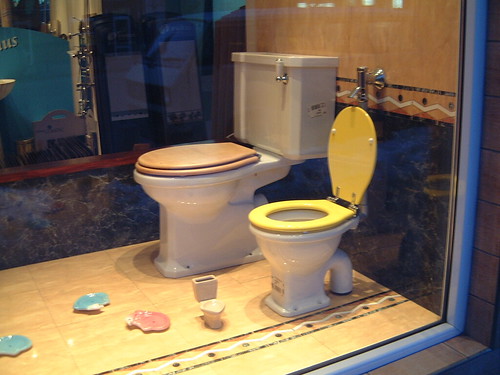
Private Toilets and Disposable Toilet Seats


While walking around in the city yesterday I realized I needed to go to the toilet. Unfortunately, I have an aversion to public toilets. They tend to be dirty and disgusting. What I would like to see are private toilet cubicles open to the public. You pay a fee, say $2, to go into this toilet and the revenue from fees goes into making this toilet clean. Perhaps the fees can go into paying the wages of someone who can clean the toilet after each person has used it.

While going to the toilet, I can usually see urine spillage on the toilet seat, and sometimes there are feces there as well. This is why I usually do not like putting my own flesh on toilet seats. This may be an irrational fear but I suspect many people have it. A way to fix this problem is to have a disposable toilet seat made out of paper. You put say 50 cents into a vending machine, get a paper toilet seat, and then attach it to the toilet, use the toilet, and then dispose of the paper toilet seat into a recycling bin. A less wasteful idea would probably be toilet seat covers.

Referring to the original private toilet cubicle idea, if the fee to pay the wages of a cleaner is too much (maybe because of uncompetitive labor market regulation by governments) then perhaps the private toilet can provide disposable toilet seats.

Image by Flickr user 80n, licensed under Creative Commons Attribution 2.0 license